🇬🇧 Ministry of Defence
Detectability of Plasma Targets in Radar
Summary
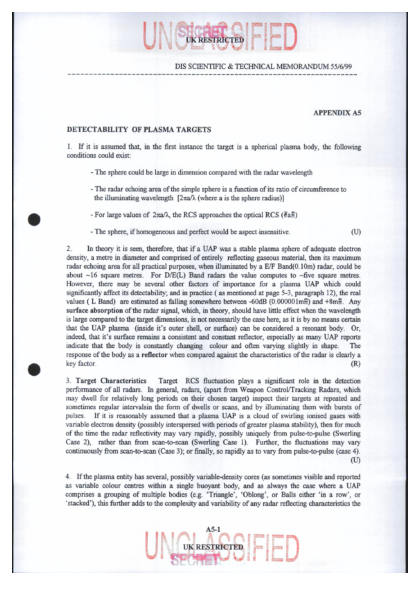
The detection of unidentified aerial phenomena (UAP) via radar becomes complex when dealing with plasma targets. A stable spherical plasma with adequate electron density can significantly reflect radar signals. For example, a plasma sphere of one meter in diameter could have a radar cross-section (RCS) of up to 16 square meters with E/F band radar. However, factors like signal absorption or plasma variability (color or shape changes) can drastically reduce detectability. Moreover, plasmas are not perfect or constant reflectors, making their tracking difficult for conventional radars.
Radar systems measure RCS to detect targets, but if the plasma fluctuates rapidly, such as with variable electron density, conventional radars may fail to capture its presence. This explains why many UAPs appear and disappear on radar screens without predictable patterns. Complexity increases further when the UAP comprises multiple bodies or has variable-density cores, generating chaotic reflections hard to interpret. In summary, plasma UAPs are hard to detect and track due to their dynamic nature and current radar limitations.