🇬🇧 Ministry of Defence
UAP, Meteorological Balloons and Other Misidentified Objects
Summary
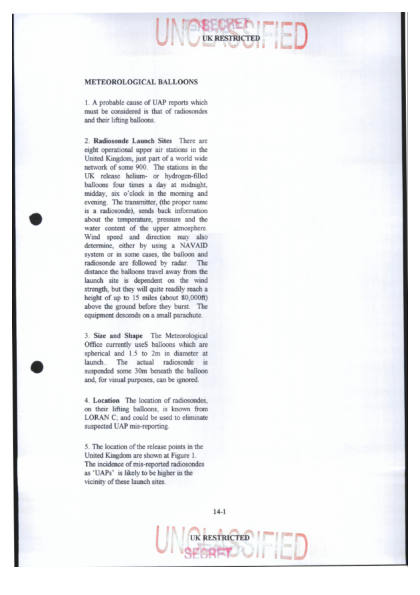
Meteorological balloons are a common cause of Unidentified Aerial Phenomena (UAP) reports due to their appearance and behavior in the sky. In the United Kingdom, there are eight operational stations that launch helium- or hydrogen-filled balloons four times a day. These balloons lift radiosondes that transmit data about temperature, pressure, and humidity in the upper atmosphere. The balloons can reach altitudes of up to 15 miles before bursting and then descend with a small parachute. Their spherical shape and the radiosonde suspended 30 meters below can be mistaken for non-conventional objects.
Additionally, meteorological balloons are often difficult to visually locate, especially from the ground, which increases the likelihood of misidentification. To help identify these objects, systems like LORAN C are used to pinpoint their location with accuracy. Despite this, UAP reports near launch sites are more frequent. This kind of confusion is especially common in rural or low-visibility areas, where observers may not be familiar with the characteristics of meteorological balloons.