🇺🇸 CIA
Soviet debates economic reforms
Summary
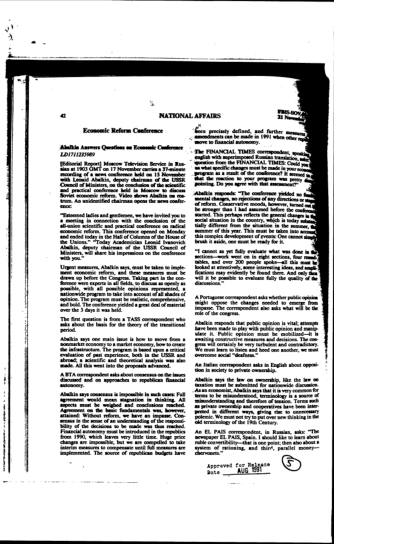
In 1989, the USSR held a scientific and practical conference on radical economic reforms. Academician Leonid Abalkin, a deputy chairman of the Council of Ministers, emphasized the need for urgent measures before the Congress. Experts from all fields participated to openly discuss a national program that would consider all opinions. The program had to be realistic, comprehensive, and bold. After three days of discussions, a large amount of material was gathered. Topics included the transition from a non-market to a market economy, financial autonomy for republics, and the need to create infrastructure. Abalkin noted that total consensus was impossible, as that would mean stagnation. However, there was agreement that without reforms, the situation was unsustainable.
Discussions also addressed private ownership, currency convertibility, and the possibility of a parallel currency. Abalkin highlighted that economic terminology was a source of misunderstanding and tension. He also rejected rationing systems, stating they were not part of the reform program. The need to mobilize public opinion and overcome "social deafness" was emphasized. The conference marked an important step toward broader and more participatory economic reforms.