🇺🇸 CIA
UFOs and Superconductors for Interstellar Travel
Summary
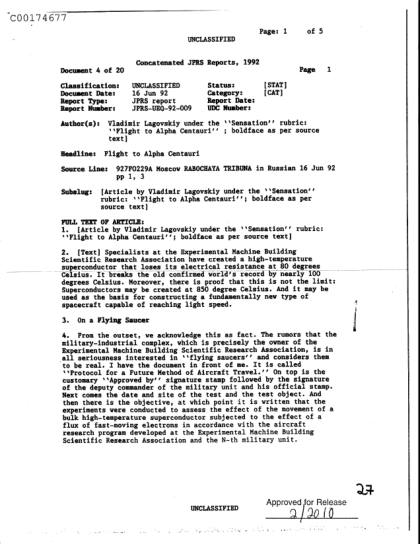
In 1992, an article published in a Russian magazine revealed research into a supposed space travel method based on high-temperature superconductors. Scientists from the Experimental Machine Building Scientific Research Association claimed to have developed a superconductor that loses electrical resistance at 80 degrees Celsius, surpassing previous records. According to the text, this material could be the basis for building spacecraft capable of reaching near-light speeds.
The article mentions a "Protocol for a Future Method of Aircraft Travel" with military signatures, suggesting serious interest from the military-industrial complex in the idea. It describes experiments with superconductors exposed to fast-moving electron flows and speculates on the possibility of creating variable-geometry crafts for both atmospheric and space travel. Although technical challenges are immense, researchers insist that theoretical principles are solid and that energy could be obtained through processes that harness energy conversion, even using common materials like iron.