🇺🇸 CIA
Poland and Air Defense After the Warsaw Pact
Summary
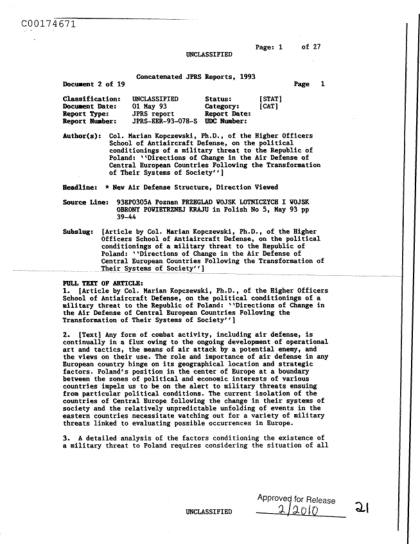
In 1993, Poland and other Central European countries faced a radical shift in their air defense strategies following the collapse of the Warsaw Pact. The article, written by Colonel Marian Kopczewski, examines how the political and social transformation of the region affected the perception and management of air threats. Poland’s geographical position, situated between diverse economic and political interests, compelled it to remain vigilant against potential conflicts. With the dissolution of the Soviet bloc, previous air defense systems—designed for collective warfare—proved inadequate. Kopczewski emphasized the need to adapt these systems to a new reality, where threats could arise not only from traditional enemies but also from technical errors, terrorist acts, or unpredictable geopolitical scenarios.
The text also addresses historical incidents highlighting the fragility of air defense systems, such as the accidental downing of civilian aircraft. In this context, a dual air defense model was proposed: one for peacetime, focused on airspace monitoring and deterrence, and another for conflict, with military response capabilities. Modernizing infrastructure and reorganizing air forces became urgent, especially considering the military power of neighbors like Germany and the uncertainty in Eastern countries. The article concludes with a strategic vision for Poland, which should lead the development of an efficient and flexible European air defense system adapted to the challenges of the 21st century.