🇺🇸 CIA
UFOs and the FCC in 1952
Summary
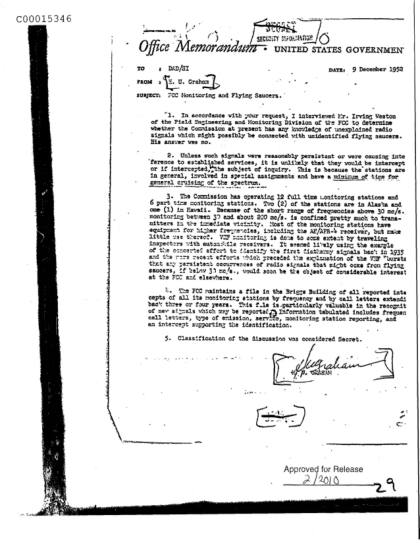
In December 1952, the Federal Communications Commission (FCC) responded to a query about unexplained radio signals potentially linked to flying saucer sightings. The report revealed that at the time, no persistent signals connected to unidentified flying objects were known. The FCC explained that its monitoring stations were focused on specific tasks and lacked resources to investigate sporadic signals. Although the FCC had a network of monitoring stations, mainly in Alaska and Hawaii, their range was limited for high frequencies. However, it was noted that any persistent signal could have been detected and recorded.
The FCC maintained a detailed file of all interceptions by its monitoring stations, including frequencies, call signs, emission types, and locations. This file was crucial for identifying new signals. Despite the report being classified as secret, it concluded there were no indications of signals related to UFOs. The document also highlights that if such signals had existed, they would have been studied for their significance. This case shows how authorities reviewed UFO reports from a technical and regulatory perspective.